As a follow-up to “How to Qualify as a Real Estate Professional for Tax Purposes,” this article focuses on how Real Estate Professionals (REP) can utilize the large tax losses produced from rental real estate, and how those tax losses can reduce or offset ordinary and portfolio income.
REP Advantage: Real Estate Tax Losses
Real estate (especially newer real estate) can be especially powerful for a REP from a tax perspective because acquisition financing and depreciation deductions may create losses that exceed the property’s current cash flow. Two deductions are often the biggest drivers:
• Interest Expense – Leveraged acquisitions frequently produce substantial interest deductions, particularly in the early years of a loan when a larger portion of debt service is attributable to interest.
• Depreciation Expense – Building and personal propery acquisition costs can generate significant depreciation deductions. While most building costs are depreciated over longer recovery periods, shorter-life property identified through a cost segregation study may qualify for accelerated depreciation, including 100% bonus depreciation where available. For more information on 100% bonus depreciation, see the Mahoney article “100% Bonus Depreciation for Real Estate: What the OBBBA Means for Investors.”
Why REP Status Matters: Passive vs. Nonpassive Losses
The value of rental losses depends on whether they are treated as passive or nonpassive. Under IRC Section 469, rental real estate losses are generally passive, and passive losses generally cannot offset ordinary income such as W-2 wages or 1099 income, nor can they offset portfolio income such as capital gains, interest, or dividends.
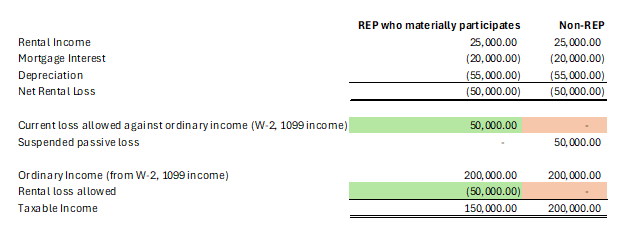
That limitation creates a timing problem. A taxpayer may have a real estate tax loss from a rental real estate, but if the loss is passive, it will be suspended instead of reducing ordinary income. By contrast, a taxpayer who qualifies as a REP may treat the rental loss as nonpassive. That nonpassive treatment can allow the loss to reduce or offset ordinary income and portfolio income, including W-2 wages, 1099 income, capital gains, interest, and dividends, as shown in the illustration below.
As you can see above, REPs and non-REPs both incur the same rental income, mortgage interest expense, and depreciation. However, only REPs benefit from being able to deduct a net rental loss from their ordinary income. Non-REPs can only deduct rental real loss against other passive income they may have; otherwise, it is suspended and carried forward.
NIIT Impact
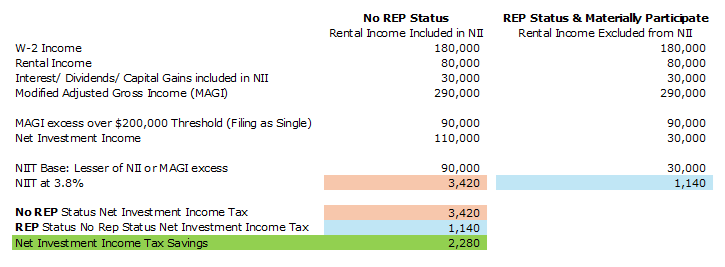
REP status also affects the 3.8% Net Investment Income (NIIT). REP status enables the NIIT exclusion for the rental income and disposition gain because the rental activity is now nonpassive. This eliminates rental income from being included in net investment income (NII) calculation as shown below. The NIIT applies to the lesser of:
• Net investment income (non-REP rental income, interest, dividends, capital gains, non-qualified annuities, and royalties), or;
• The amount by which modified adjusted gross income (adjusted gross income plus any foreign earned income) exceeds a threshold of $200,000 for single filers, or $250,000 for married taxpayers filing jointly.
Takeaway
Overall, the value of REP status is the prevention of premature income recognition due to passive losses and the exclusion of rental income from the NIIT calculation. Newer real estate can produce substantial deductions through interest expense and depreciation, often culminating in a net rental loss that a REP can treat as nonpassive. Those losses can reduce or offset ordinary and portfolio income that passive losses cannot. For that reason, taxpayers with significant real estate activity should pursue REP status to maximize their tax efficiency.